Last week I spent a few days in Las Vegas for OPTECH by NMHC. For someone obsessed with wireless and RF, OPTECH was the perfect testbed. The venue was packed with MSPs, manufacturers, and vertical tech experts. It offered a rare, real-world opportunity to validate Wi-Fi 7 performance surrounded by hundreds of access points from multiple vendors and management systems.
Gamified Speed Testing—Personal Lessons in Wi-Fi 7
Instead of simply showing off hardware, I built a speed test game with a React frontend wrapped around LibreSpeed and invited attendees to compete for the best download and upload scores. Most people didn't realize their devices were already Wi-Fi 7 or at least 6GHz-capable until they saw their names pop up on the leaderboard. That competitive twist sparked more conversations and excitement than I expected, with plenty of talk about the RUCKUS portfolio and the practical impact of cutting-edge Wi-Fi.
Personal Touch:
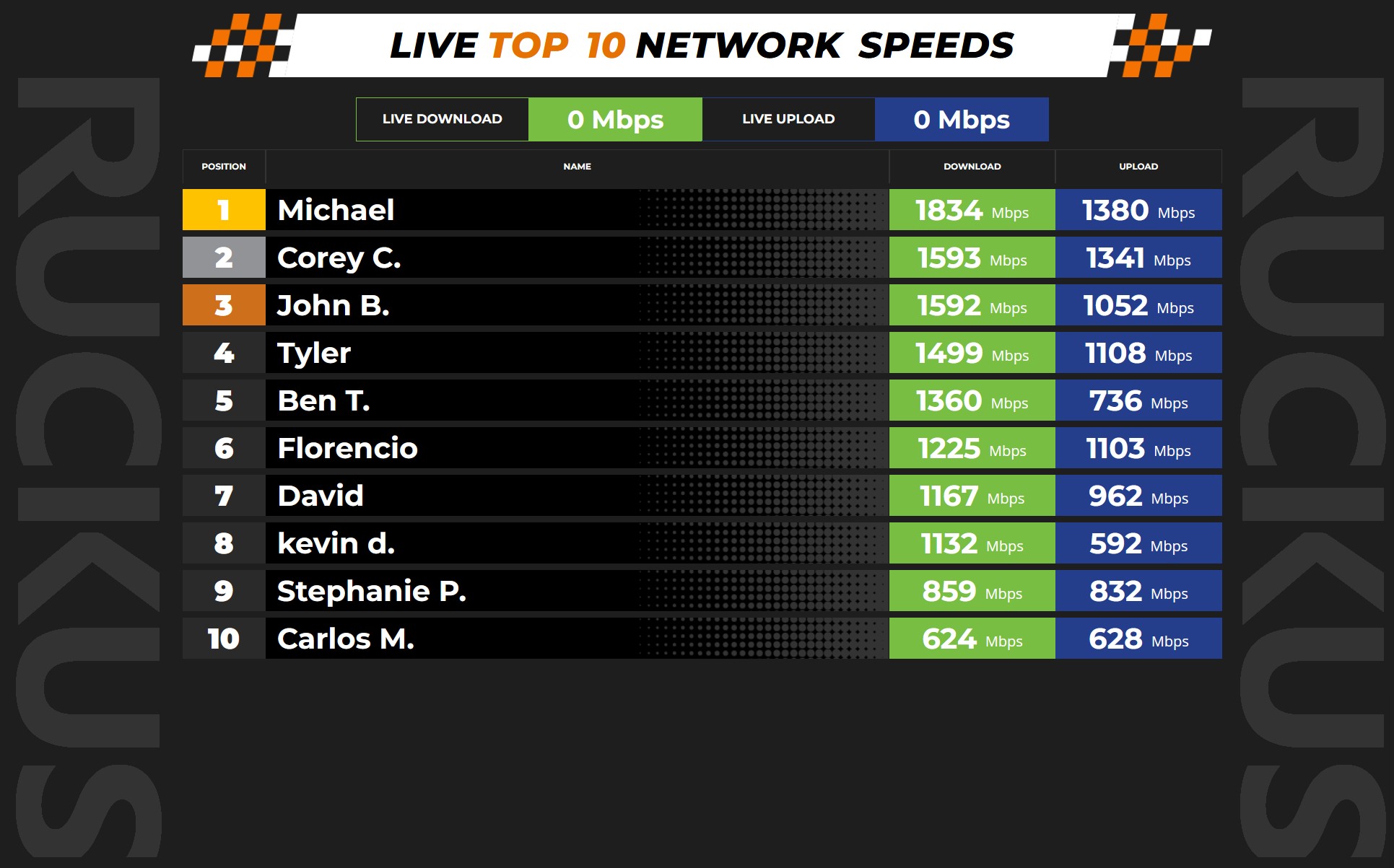
One highlight was Michael, who topped the leaderboard with a blazing 1,834 Mbps down and 1,380 Mbps up. He’d just upgraded to a new iPhone Air and had no idea of its full capabilities. When we spoke after the event and I let him know he'd placed first, he was genuinely delighted. It gave us both a real-world snapshot of theoretical Wi-Fi 7 conversations coming to life.
Device Insights
During the event, a total of 68 unique devices participated in the speed test challenge—split almost evenly across platforms:
- 31 Apple devices
- 37 Android devices
Of those, 43 were 6GHz capable. That's over 63%. This highlights just how widely Wi-Fi 6E and Wi-Fi 7 adoption has spread among everyday users. Nearly two-thirds of participants had devices ready for the newest bands. This is a real-world indicator of rapid, mainstream next-gen Wi-Fi integration. Many attendees discovered these capabilities for the first time, leading to a few "aha moments" and a better understanding of the performance advantage that Wi-Fi 7 and 6GHz bands deliver.
My Setup
The network was straightforward but built for performance:
- 2 RUCKUS R770 access points (10Gbps uplinks)
- RUCKUS ICX8200-C08ZP switch (20Gbps LAG to Dell VEP 1485)
- Dell VEP 1485 (front/backend for speed test app)
- MikroTik RB5009UPr+S+in (2.5Gbps uplink for routing & DHCP)
No internet required, since conference network connections are infamously unpredictable. Two SSIDs, each on separate APs, kept the competition fair. The setup allowed up to six players per lobby, but most tests were head-to-head, maximizing each AP’s bandwidth for every run.
The results of the game certainly met my goals, but attendees' reactions, especially those of first-time Wi-Fi 7 users, were priceless. Here's a sample of the (non-final) leaderboard during the action. The screenshot here is scrubbed of the scores of RUCKUS employees that participated in the challenge.
Access Point Density: Every Square Foot Counts
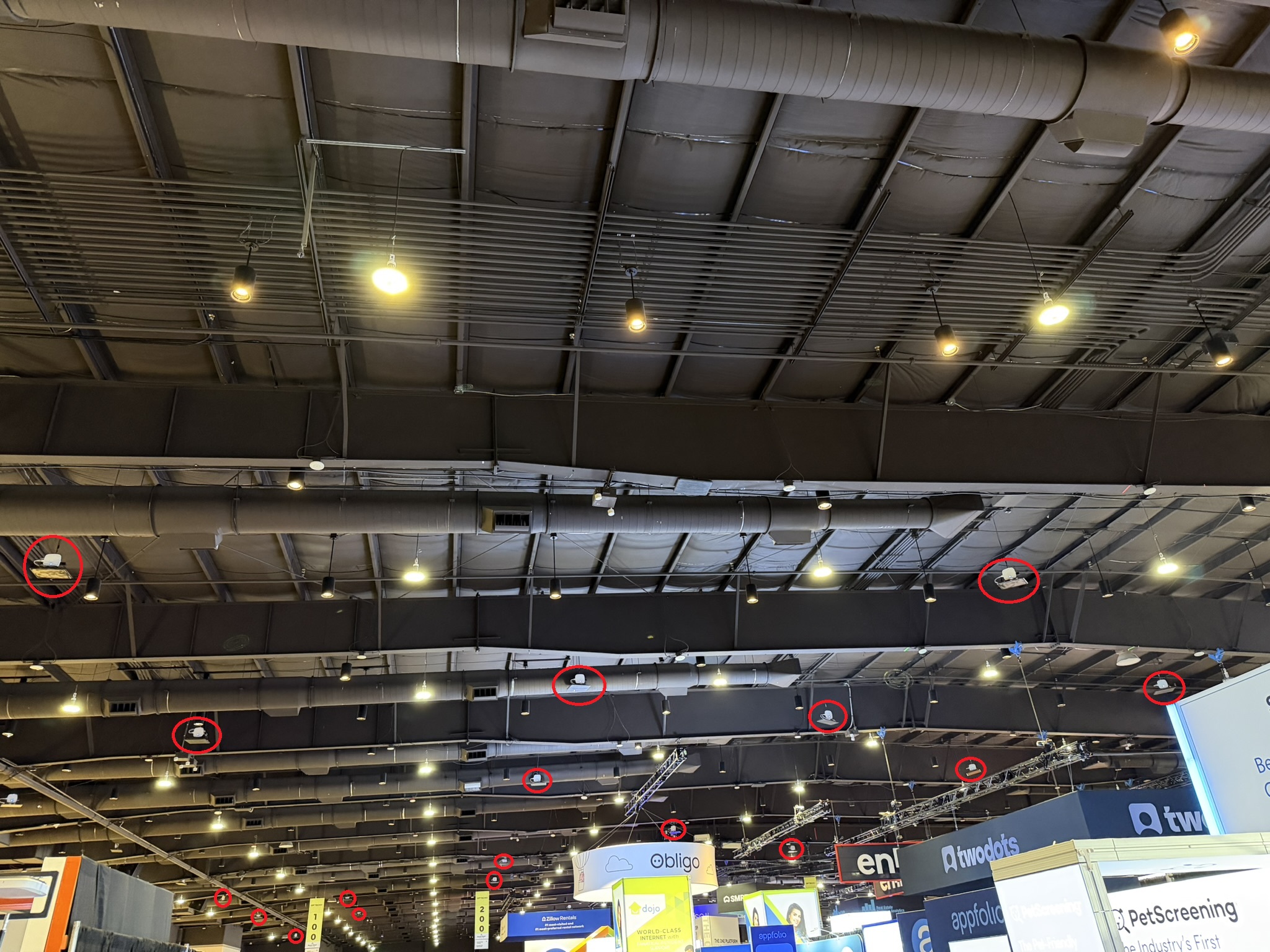
Operating my demo at OPTECH meant deploying just two APs in a dense environment managed almost entirely by the venue and other exhibitors. From my booth, the ceiling was a map of APs. Here's a look, with each visible access point circled in red. This image is just a small slice of the total deployment, which stretched across the expo hall with hundreds of APs from multiple vendors and management systems.
The venue's design featured patch antennas aimed for precise coverage and significant overlap, carefully planned with a static channel plan. But the additional exhibitor APs, including mine, stacked on more unpredictable interference. Running a live Wi-Fi 7 demo in this crowded "RF jungle" was a true test of what today's wireless technologies can offer.
Spectrum Analysis: 5GHz in Practice
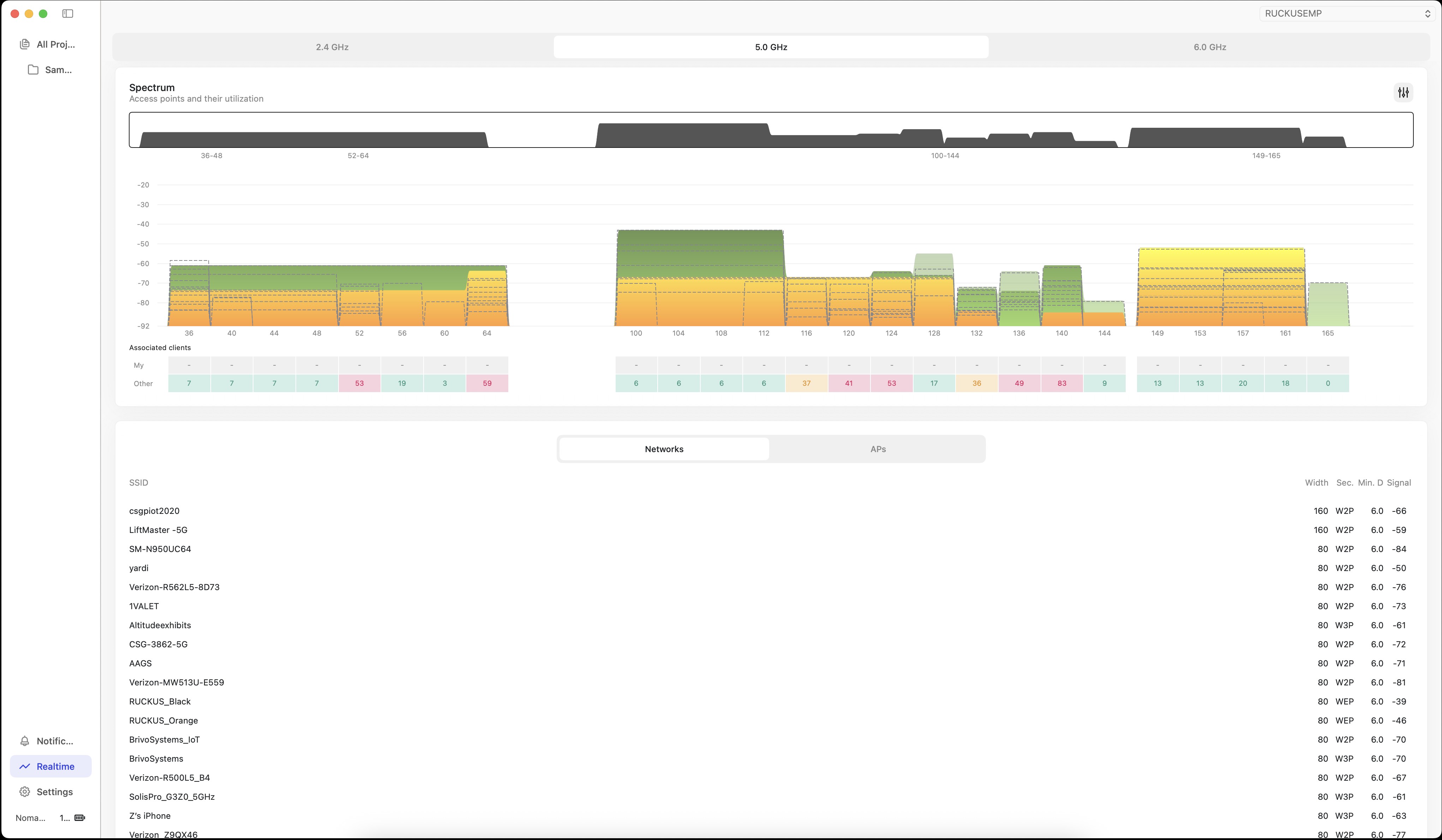
To further illustrate the challenge on 5GHz, here’s a snapshot from Hamina Onsite taken during the event. The visualization shows extensive channel utilization, significant overlap, and many APs operating wide channels within a busy RF environment.
Real-World Performance: 5GHz and 6GHz
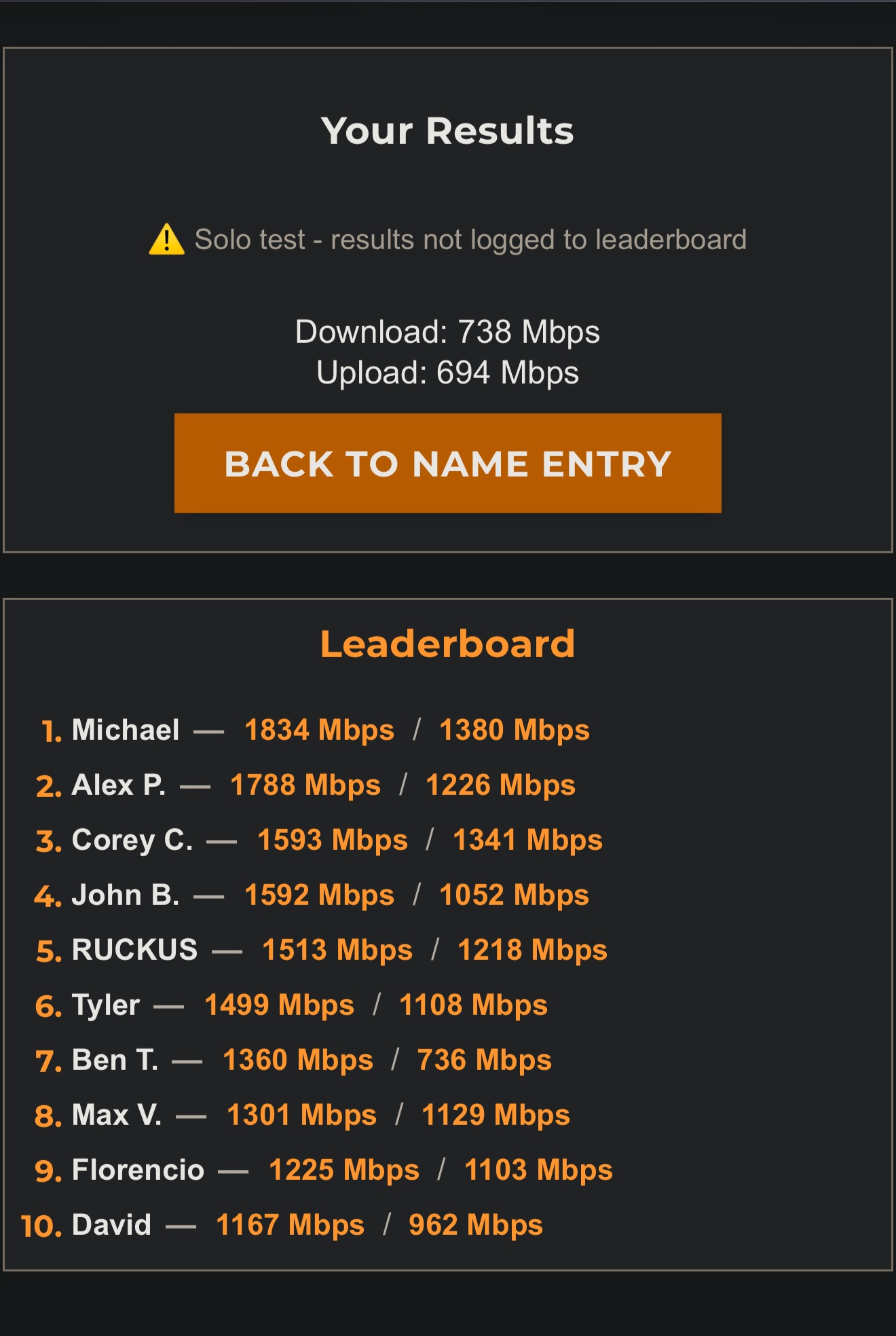
My solo test in the thick of the crowd, using 5GHz (utilizing Wi-Fi 7), landed at 738 Mbps down, 694 Mbps up. Those are pretty solid speeds considering the overhead and spectrum competition. The leaderboard was packed, with all top ten scores breaking 1 Gbps, but to be clear: the top results, like Michael's, were reached on 6GHz. Those headline speeds are a testament to the performance increases we see with the 6GHz spectrum.
What Worked: RUCKUS R770s and Real-World Wi-Fi 7
My demo ran off RUCKUS R770 access points, managed in the cloud via RUCKUS One. Despite the packed spectrum, wide channels and modulation advances (hello, preamble puncturing and 4K QAM) let clients routinely hit impressive speeds on both 5GHz and 6GHz, though only 6GHz delivered the highest scores above 1Gbps.
Technical Deep Dive – Preamble Puncturing
It’s also worth noting that the venue’s house networks operated on Wi-Fi 6. Although my capture data isn’t conclusive, Wi-Fi 7 enables “preamble puncturing”. This allows use of the clean portions of a wide channel even if part of it is interfered with by legacy networks. Instead of shrinking down to only 20 MHz or 40 MHz in busy spectrum, a Wi-Fi 7 network can transmit on available segments of a wider 80 MHz or 160 MHz channel. This capability is a leap forward for throughput in dense, multi-operator environments like OPTECH.
Lessons Learned (For Me)
For all the technical talk, my biggest takeaway was just how many people already have Wi-Fi 7 and 6GHz devices, even if they're not aware of it. Building the speed test frontend was a satisfying challenge, and helping non-RF folks see Wi-Fi 7 in action was a real highlight. Each demo, every conversation, helped me grow as an engineer, especially in environments as complex as multifamily and large venues. Although these verticals differ, mostly from a layer 2 perspective, they are both challenging in their similar high-density requirements.
Thanks for Reading
If you stopped by the RUCKUS booth, played the game, or talked shop, thanks for making it an awesome field test. I work with an exceptional team and have amazing customers and colleagues. Every show, every crowded ceiling, is just another step in the RF journey. If you're curious about practical Wi-Fi engineering or have war stories of your own, let's connect.
Alek (N4OG)